
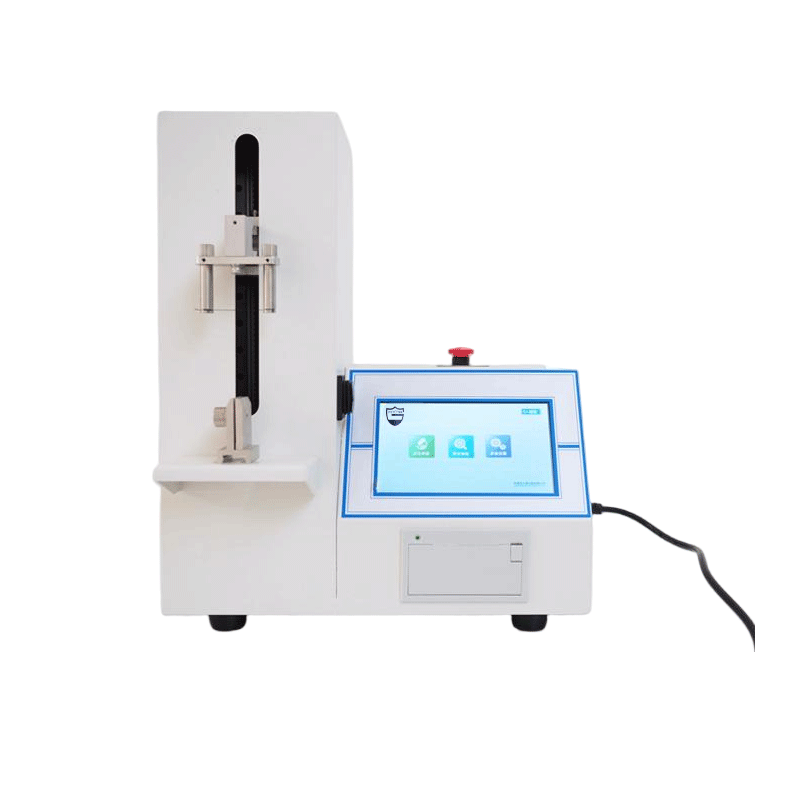
PYT-019 Surgical Blade Sharpness Tester
The Peyotal PYT-019 Surgical Blade Sharpness Tester utilizes an advanced low-impedance micro-force sensor paired with a high-rigidity linear drive mechanism to capture instantaneous cutting peak loads with a fine resolution of 0.001 N. The system features a specialized suture and simulation media clamping apparatus that applies a calibrated 100g tension weight to maintain constant, uniform media resistance across all testing routines. Operating at programmable vertical cutting speeds from 0 to 600 mm/min (up to 10 mm/s), the instrument automatically traces dynamic force-displacement curves on the integrated touchscreen to verify cutting edge uniformity, flatness, and peak sharpness. Built into a compact 11 kg benchtop chassis with an integrated micro printer, this automated machine delivers operator-independent data logging for surgical scalpel production plants, cleanroom packaging facilities, and scientific regulatory laboratories across Southeast Asia, Central Asia, Africa, and Latin America.
product details
The Surgical Blade Sharpness Tester (Model: PYT-019) is a high-precision, laboratory-grade testing system designed and manufactured by Peyotal. Built for quantitative sharpness and cutting resistance measurement, this apparatus evaluates disposable surgical blades, stainless steel scalpels, and ophthalmic micro-knives by recording the maximum cutting peak force when penetrating calibrated sutures, specialized silicone membranes, or simulated skin media.
Standards: Fully compliant with medical blade regulatory standards including YY 0174-2019 and YY 0876-2013.
| Model | PYT-019 |
| Brand | Peyotal |
| Testing Principle | Precision vertical penetration through calibrated weighted suture or silicone test media to capture cutting resistance profiles and peak incision loads. |
| Standard Compliance | YY 0174-2019 / YY 0876-2013 |
| Chassis Size | 400 mm (L) * 270 mm (W) * 360 mm (H) |
| Warranty | 12 months |
| Specification Item | Technical Data & Testing Performance |
| Primary Laboratory Application | Quantitative sharpness and cutting force measurement for surgical scalpels and micro-blades |
| Compatible Blade Types | Disposable surgical blades, stainless steel scalpels, ophthalmic knives, microtome blades |
| Measurement Force Range | 0 to 15 N micro-force detection capacity |
| Force Measurement Accuracy | 0.001 N ultra-high sensitivity resolution |
| Controlled Test Entry Speed | Adjustable from 0 to 600 mm/min (up to 10 mm/s controlled linear speed) |
| Standardized Test Media | Calibrated suture wire with 100g tension / Dedicated standard test silicone film |
| Sensor Hardware Core | Professional low-impedance micro-force sensor with rapid micro-peak data capture |
| Display & Data Analytics | Touchscreen real-time curve display, maximum peak force, and average cutting force calculation |
| Quality Output Architecture | Integrated micro printer for instant physical test receipt generation and batch statistics |
| Standard Configuration | Host Machine, Dedicated Clamping Fixture, 100g Tension Weight, Printing Paper, User Manual |
Q1: What is the exact laboratory testing principle and workflow for measuring surgical blade sharpness?
A: The test evaluates the instantaneous force required for a blade edge to slice through a tensioned target medium. The blade specimen is mounted onto the vertical drive fixture. One end of a standardized suture is clamped, while the opposite end is weighted with a calibrated 100g mass to maintain constant horizontal tension before being secured into the second clamp. The drive mechanism lowers the blade vertically at a steady speed (not exceeding 10 mm/s) to slice through the center of the suspended suture. The low-impedance sensor immediately captures and records the exact peak force required to complete the cut.
Q2: How does the system evaluate blade edge uniformity and flatness?
A: The integrated software plots real-time force-displacement curves throughout the entire incision stroke. By analyzing the smoothness of the curve, peak transition points, and the average cutting force, quality engineers can identify microscopic burrs, irregular bevel grinds, or inconsistent edge honing along the blade length.
Q3: Can the PYT-019 test specialized micro-blades like ophthalmic knives?
A: Yes. The system is equipped with an ultra-sensitive 0 to 15 N sensor range with 0.001 N resolution, making it suitable for delicate ophthalmic knives, micro-keratomes, and ultra-sharp micro-incision tools that require precise measurement of low cutting forces.
Q4: What components and utilities are required for routine benchtop operation?
A: The PYT-019 operates on standard single-phase electrical outlets (220V / 50Hz or 110V / 60Hz) and requires no external air compressors or fluid supplies. The standard delivery package includes the testing mainframe, specialized blade and suture clamping fixtures, a calibrated 100g tensioning weight, a roll of thermal printing paper, a power cord, and an operation manual.
For Immediate Assistance, Please Contact us Now!
Contact Us
- 24-hour online service
- Own factory processing