

Regulatory surveillance across Southeast Asia’s largest consumer market has shifted sharply toward post-market verification, turning condom micro-pinhole detection into a critical compliance benchmark for international medical device suppliers. Indonesia’s National Agency of Drug and Food Control (Badan Pengawas Obat dan Makanan, or BPOM) has expanded random retail sampling and maritime border audits across Jakarta, Surabaya, and Medan. Under updated import distribution directives aligned with SNI ISO 4074, shipments of male natural rubber latex condoms face mandatory customs release screening where barrier micro-apertures trigger immediate lot rejections.
While export factories routinely release finished stock backed by clean high-speed electronic screening logs, BPOM border laboratories frequently detect electrical conductance failures and micro-droplet seepage during liquid verification. Discrepancies between dry factory screening and destination liquid audits create costly container demurrage, mandatory destruction orders, and suspension of BPOM distribution licenses (Nomor Izin Edar / NIE).
The Audit Core: How Tropical Storage Exposes Micro-Defects Under SNI ISO 4074
Indonesia’s maritime climate—characterized by persistent 85%+ relative humidity and ambient temperatures exceeding 32°C—accelerates polymer stress relaxation. When latex films contain latent structural flaws, equatorial shipping lanes and warehouse storage exacerbate barrier failure through distinct physical mechanisms:
1. The 20–50 µm Pinhole Detection Blind Spot
- Testing Protocol: Under SNI ISO 4074 Annex M (water leakage test), condoms are filled with 300 ml of purified water, suspended for a specified dwell time, and rolled over absorbent blotting paper to detect wetting. Alternatively, Annex N utilizes an electrolyte bath with a calibrated low-voltage sensor circuit to identify conductive liquid channels across the barrier.
- Audit Failure Mechanism: High-speed factory production lines typically rely on dry electrostatic screening over metal mandrels at lines exceeding 250 units per minute. If mold release powders (such as calcium carbonate or cornstarch) or excessive dimethicone silicone oil bridge a micro-tear smaller than 50 µm, the electrostatic arc fails to jump the air gap, registering a false pass. Once the device arrives in Indonesia and liquid lubricant dissolves the powder bridge, water penetrates immediately.
2. Air Burst Volume & Thermal Degradation Resistance
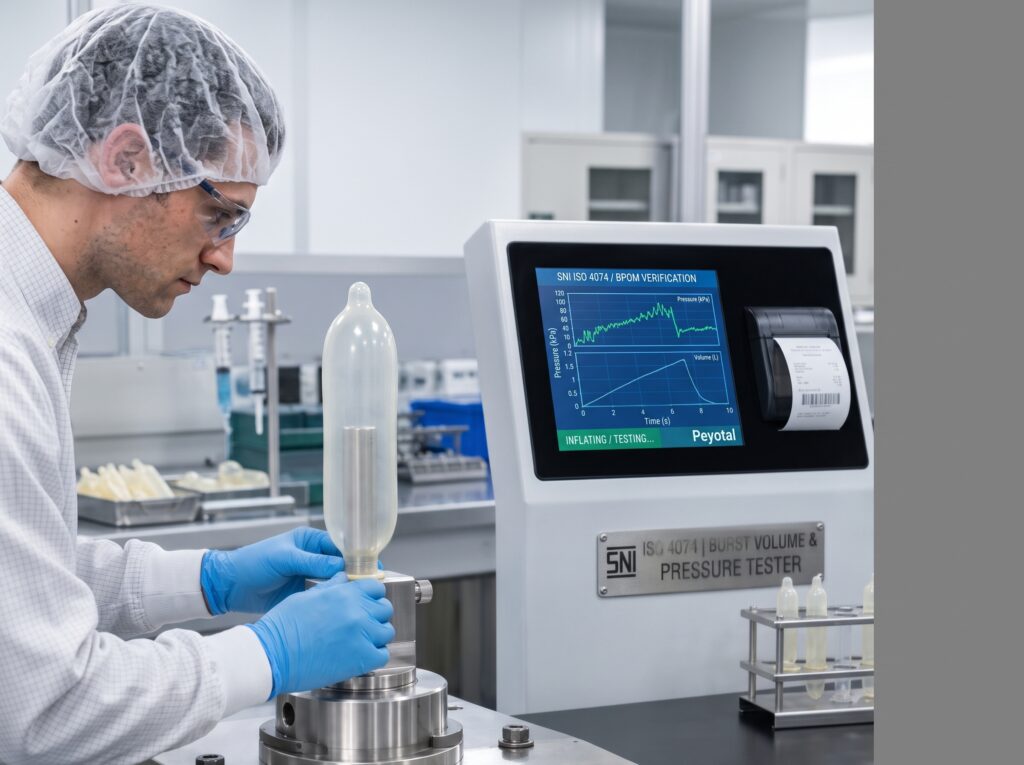
- Testing Protocol: BPOM verification audits evaluate barrier elasticity via continuous air inflation at 24–30 dm³/min until burst, confirming minimum burst volume (typically 16.0 dm³ to 18.0 dm³) and pressure (1.0 kPa).
- Audit Failure Mechanism: Latex compounding lacking anti-ozonant protection suffers localized cross-link scission when exposed to port warehouse humidity. Deploying an automated Condom Air Burst Testing Machine verifies baseline tensile retention before containers depart, preventing brittle mid-body bursts during regulatory sampling.
Protocol Comparison: In-Line Factory QC vs. BPOM Regulatory Inspection
| Verification Metric | In-Line Manufacturing Screening | BPOM Port & Post-Market Audit (SNI ISO 4074) | Primary Root Cause of Lot Failure |
| Leak-Tightness Method | High-speed dry electronic mandrel | Suspended water fill / electrolyte bath immersion | Powder and silicone masking 20–50 µm micro-pores |
| Inspection Sample Size | 100% automated rapid run | AQL 0.25 statistical lot sampling | False-pass units slipping into bulk cartons |
| Burst Parameters | Periodic batch spot-checks | Regulated chamber inflation (24–30 dm³/min) | Flow rate variance distorting volume thresholds |
| Traceability Record | Line tally counters | Tamper-proof digital logs with test curves | Lack of auditable test documentation for customs |
Peyotal Instrumentation: Eliminating Border Rejection Risks
Securing uninterrupted clearance through Indonesian ports requires factory laboratories to replicate the exact fluid and pneumatic stresses utilized by BPOM inspection laboratories.
At Peyotal Instrument, our testing systems provide laboratory-grade verification engineered around international barrier monographs:
- Peyotal Condom Water Leakage Testing Machine: Designed specifically for SNI ISO 4074 Annex M verification, incorporating precision fluid metering, automated suspension racks, and standardized rolling mandrels to identify sub-50 µm seepage.
- Peyotal PYT-140 Automated Condom Burst Tester: Features closed-loop aeration control delivering steady 24–30 dm³/min flow rates, high-precision pressure transducers (0.01 kPa resolution), and built-in thermal printing to produce unalterable QC archives for regulatory submissions.
- Comprehensive Quality Solutions: Supporting medical consumable manufacturers across Southeast Asia, Central Asia, and Latin America with testing machinery that bridges the gap between high-speed assembly and rigorous border compliance.
Standardizing pre-shipment quality protocols to BPOM benchmarks safeguards export investments, maintains distribution licenses, and protects commercial brand equity across Indonesian healthcare channels.
- Explore Medical Testing Equipment: Peyotal Laboratory Solutions
- Direct Engineering & Quotation Inquiries: Vincent@peyotalinstrument.com