

Uzbekistan’s regulatory modernization under the Agency for the Development of the Pharmaceutical Industry and the Ministry of Health has established strict localized manufacturing criteria, transforming laboratory testing equipment into a core compliance requirement for domestic plants. Under Decree No. UP-137 and updated national GMP inspection frameworks, domestic production lines for sterile medical consumables—ranging from single-use hypodermic syringes and infusion sets to blood collection needles—must demonstrate comprehensive in-house mechanical verification capabilities to secure product approval.
Historically, regional packaging operations could clear regulatory audits relying on external testing summaries or supplier material certifications. Under current inspection protocols, localized manufacturing licensing and Uzbekistan medical device registration require operational factory laboratories capable of validating raw material performance, barrel molding consistency, and mechanical safety on site. Facilities lacking calibrated instrumentation to conduct batch-level puncture, sliding, and leak audits face immediate corrective action notices or registration refusals.
The Audit Focus: Physical Verification Benchmarks for Needles and Syringes
National GMP auditors inspect whether cleanroom manufacturing translates into measurable physical performance. For sterile single-use plastics and puncture consumables, inspectorate focus centers on three critical parameters:
1. Medical Needle Puncture Force Verification (ISO 7864 & ISO 9626)
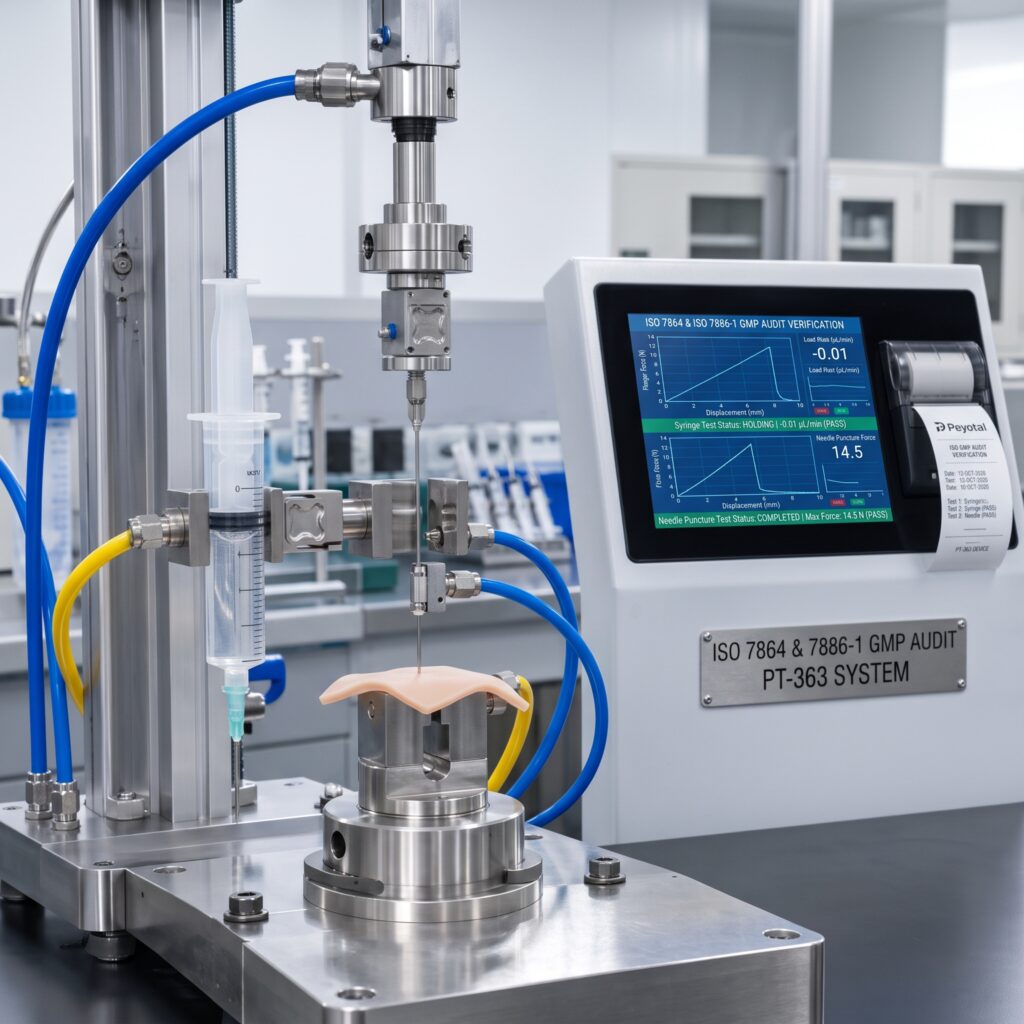
- Technical Requirement: Needle tip bevel sharpness and silicone coating uniformity directly determine tissue penetration resistance. During GMP evaluations, inspectors verify the maximum puncture force as the cannula penetrates an artificial substrate at a controlled test velocity (typically 100 mm/min).
- Audit Failure Point: Excessive peak puncture force indicates dull tooling, grinding burrs, or inconsistent silicone lubrication. Utilizing an automated [Medical Needle Puncture Force Tester] delivers the continuous force displacement curve required by auditors to demonstrate lot uniformity.
2. Syringe Plunger Sliding Dynamics & Force Limits (ISO 7886-1 Annex E)
- Technical Requirement: Plungers must actuate without erratic sticking. Regulatory protocols mandate tracking both initial break-loose force (initiating piston movement) and sustained operating force (maintaining fluid expulsion) across the barrel stroke.
- Audit Failure Point: Manual push tests fail to satisfy audit logging requirements. Deploying a dedicated [Medical Syringe Sliding Performance Tester] ensures measurable verification against national force limits, preventing piston hesitation during clinical use.
3. Cannula Rigidity and Deflection Resistance (ISO 9626)
- Technical Requirement: Stainless steel needle tubing must withstand bending loads without permanent angular deformation or brittle snapping.
- Audit Failure Point: Using unregulated shop-floor weights fails to satisfy traceability requirements. Implementing a calibrated [Medical Needle Stiffness Tester] provides digital angle-load readouts that satisfy GMP verification dossiers.
Eliminating the Quality Gap in Localized Consumable QC
Establishing localized medical manufacturing in Central Asia involves distinct supply chain and environmental variables that standard overseas SOPs do not address:
- Polymer Compounding and Barrel Shrinkage: Local injection molding operations using alternative polypropylene grades often experience mold shrinkage variances. Without continuous barrel-to-stopper mechanical verification, subtle inner-diameter fluctuations result in piston stall or fluid bypass.
- Cannula Grinding Consistency: High-speed needle assembly lines experience grinding wheel wear that dulls cannula lancet bevels over production shifts. Routine sampling with dedicated laboratory testing equipment catches burrs before large batches enter cleanroom blister packaging.
- Unalterable Data Logging: Uzbekistan’s technical committees require traceable testing records. Handwritten test sheets without real-time force curves or digital timestamps are flagged during on-site GMP facility assessments.
Verification Protocol Comparison: Import Assembly vs. National GMP Standards
| Inspection Metric | Assembly Line Practice | Uzbekistan GMP In-House Standard | Compliance Risk |
| Needle Puncture Force | Supplier Certificate of Analysis (CoA) | In-line sampling with calibrated force transducers | Registration hold due to lack of local testing capacity |
| Plunger Glide Force | Manual push-pull tactile check | Constant-speed mechanical drive with curve logging | Plunger jamming non-conformities during hospital use |
| Cannula Rigidity | Generic metal mill certificate | Standard 3-point bending under ISO 9626 | Brittle needle failures during clinical injection |
| Test Traceability | Shift logbook entries | PLC digital acquisition with thermal report printout | Audit non-conformity for non-verifiable data trails |
Peyotal Testing Solutions for Central Asian Manufacturing
To help medical device plants satisfy national regulatory frameworks and maintain comprehensive consumable QC, [Peyotal Instrument] supplies complete mechanical verification benches engineered to international standards:
- [Peyotal PYT-361 Medical Needle Puncture Force Tester] : Features high-resolution load cells (0.01 N precision), adjustable feed speeds, and real-time peak-force capture for hypodermic, intravenous, and suture needles.
- [Peyotal PYT-362 Medical Needle Stiffness Tester] : Delivers standardized deflection testing for medical tubing and rigid cannulas according to ISO 9626, providing objective deflection logs for regulatory dossiers.
- [Peyotal PT-365 Medical Syringe Sliding Performance Tester] : Evaluates break-loose and sustained glide mechanics across syringe sizes from 1 ml to 60 ml, ensuring compliance with ISO 7886-1 glide force parameters.
- Turnkey Quality Control Infrastructure: Each instrument includes calibration certificates, traceable data outputs, and complete operational manuals, enabling Central Asian manufacturers to satisfy registration audits.
Equipping cleanroom laboratories with dedicated mechanical testing stations eliminates regulatory delays, expedites state registration, and secures domestic supply contracts across Uzbekistan.
- Explore Medical Testing Equipment: [Peyotal Testing Solutions]
- Technical Consultation & Quotation Requests: Vincent@peyotalinstrument.com