
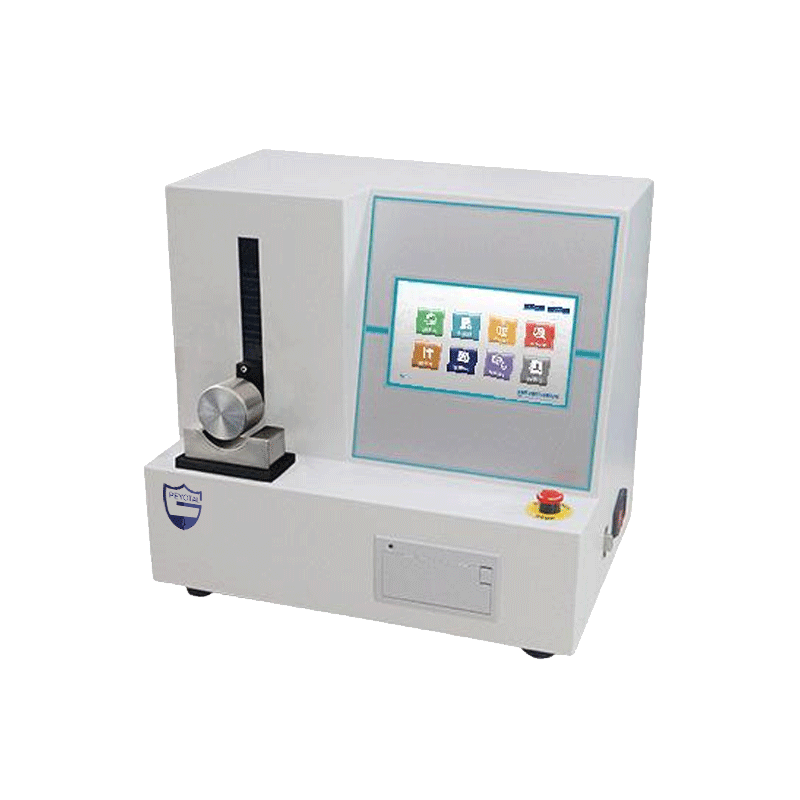
PYT-020 Surgical Blade Elasticity Tester
The Peyotal PYT-020 Surgical Blade Elasticity Tester utilizes a high-precision servo drive mechanism combined with a dedicated positioning clamp base and standard angle gauge to ensure strict axial centering and repeatable load application. During execution, the system applies a controlled force to the center of the blade using a specified cylindrical mold column, holds the deflection for an automated 10-second duration, removes the load, and measures the resulting residual deformation. Accommodating mold column diameters of 88mm, 85mm, and 98mm with a linear travel stroke of 0 to 30mm, this automated apparatus eliminates human-induced angle and force errors. Built into a compact 11 kg benchtop chassis with an on-board thermal printer, the PYT-020 delivers standardized data logging for scalpel manufacturing plants, cleanroom packaging facilities, and scientific regulatory testing laboratories across Southeast Asia, Central Asia, Africa, and Latin America.
product details
The Surgical Blade Elasticity Tester (Model: PYT-020) is a dedicated laboratory verification system engineered and manufactured by Peyotal. Designed to evaluate the elastic recovery, bending deflection resilience, and fracture resistance of metal surgical blades and scalpels after exposure to specified lateral loads or bending angles, this apparatus provides a reliable quality control method to prevent blade snapping, permanent plastic deformation, or intraoperative disengagement during surgical procedures.
Standards: Fully compliant with the medical surgical blade standard YY 0174.
| Model | PYT-020 |
| Brand | Peyotal |
| Testing Principle | Precision mold column bending loading to a set deflection, 10-second pressure holding, automated unloading, and quantitative residual deformation measurement. |
| Standard Compliance | YY 0174 |
| Chassis Size | 400 mm (L) * 270 mm (W) * 360 mm (H) |
| Warranty | 12 months |
| Specification Item | Technical Data & Testing Performance |
| Primary Laboratory Application | Elastic recovery, bending resilience, and fracture resistance testing for surgical blades |
| Compatible Blade Types | Stainless steel scalpels, carbon steel surgical blades, micro-cutting blades |
| Mold Column Diameters | 88mm, 85mm, and 98mm standardized cylindrical tooling |
| Spacer Diameter Specification | D + 0.4 mm precision clearance matching |
| Linear Moving Distance | 0 to 30 mm travel displacement |
| Holding Time Duration | 10 seconds automated dwell cycle before unloading |
| Drive Mechanism Architecture | High-precision servo drive system eliminating manual operation variances |
| Clamping & Centering Layout | Dedicated positioning clamp base with integrated standard bending angle gauge |
| Test Process Automation | Automated bending, dwell timing, load release, and residual deformation detection |
| Report Output Hardware | Built-in on-board thermal printer for real-time receipt generation and batch logging |
| Standard Configuration | Host Machine, Dedicated Clamping Fixture, Thermal Printing Paper, Instruction Manual |
Q1: What is the exact laboratory testing principle and workflow for measuring surgical blade elasticity?
A: The test evaluates whether a blade can recover its original straight profile after experiencing severe bending stress. The blade specimen is secured onto the dedicated positioning clamp base. The servo drive mechanism lowers the specified mold column against the center of the blade to bend it to a predefined deflection. The system maintains this flexed state for exactly 10 seconds. After the dwell period, the load is automatically removed, and the sensor measures any residual plastic deformation to determine if the blade satisfies standard elastic recovery criteria.
Q2: Why is testing blade elasticity and fracture resistance critical for surgical safety?
A: During surgery, scalpels frequently encounter tough cartilage, dense fibrous tissue, or bone contact that exerts lateral bending forces. If a blade has insufficient elasticity, it will bend permanently, impairing surgical precision. If the metal is excessively brittle, the blade risks snapping inside the surgical site, causing dangerous clinical complications. Testing ensures an optimal balance between blade hardness and flexural toughness.
Q3: How does the servo drive system improve testing accuracy compared to manual testing methods?
A: Manual bending fixtures rely on operator force and visual angle estimation, leading to inconsistent bending rates and timing errors. The PYT-020 employs a precision servo drive and automated electronic timing that regulates bending displacement and maintains the 10-second dwell time within narrow tolerances, ensuring operator-independent, audit-ready data.
Q4: What facility utilities and accessories are included in the delivery package?
A: The PYT-020 is designed for standalone benchtop operation on standard single-phase AC power (220V / 50Hz or 110V / 60Hz) without requiring external compressed air lines. The standard factory package includes the tester mainframe, specialized blade positioning fixtures and mold tooling, a roll of thermal printing paper, a power cord, and an operation manual.
For Immediate Assistance, Please Contact us Now!
Contact Us
- 24-hour online service
- Own factory processing