
In the global medical consumable manufacturing sector, precision and sterility are paramount. Hypodermic syringes represent one of the highest-volume single-use medical devices worldwide. However, even a microscopic structural flaw or an unstable seal between the barrel and plunger can result in dosage inaccuracies, medication contamination, or hazardous air intake during aspiration.
As regulatory scrutiny intensifies across emerging manufacturing hubs in Southeast Asia, Latin America, Central Asia, and Africa, medical device producers face increasing pressure to upgrade their quality assurance protocols.
Understanding how automated negative pressure tightness testing functions—and aligning production lines with international standards like ISO 7886-1—is essential for achieving zero-defect compliance.
The Critical Need for Syringe Air Leakage Testing
Syringe body integrity depends heavily on the interface fit between the elastomeric piston and the polymer barrel. During clinical procedures, syringes operate under variable pressure dynamics:
- Aspiration (Negative Pressure): Drawing fluid creates a vacuum inside the barrel. If the seal fails, ambient air enters, compromising volume accuracy and introducing potential contaminants.
- Injection (Positive Pressure): Depressing the plunger creates hydraulic force. A compromised barrel-to-nozzle connection or piston failure can lead to medication leakage.
Traditional manual water immersion tests often lack repeatability and depend heavily on operator inspection. Modern automated testing instruments eliminate human error by creating closed-loop, programmable test environments with precise pressure monitoring.
Technical Mechanism: Negative Pressure Leakage Testing (ISO 7886-1)
According to ISO 7886-1 (Sterile hypodermic syringes for single use), evaluating syringe barrel tightness under vacuum requires continuous negative pressure retention without drift.
Step-by-Step Testing Protocol:
- Preparation: The syringe draws water to not less than 25% of its nominal capacity with the nozzle facing upward.
- Plunger Alignment: The plunger is retracted to align with the nominal capacity graduation line and mounted securely into the fixture.
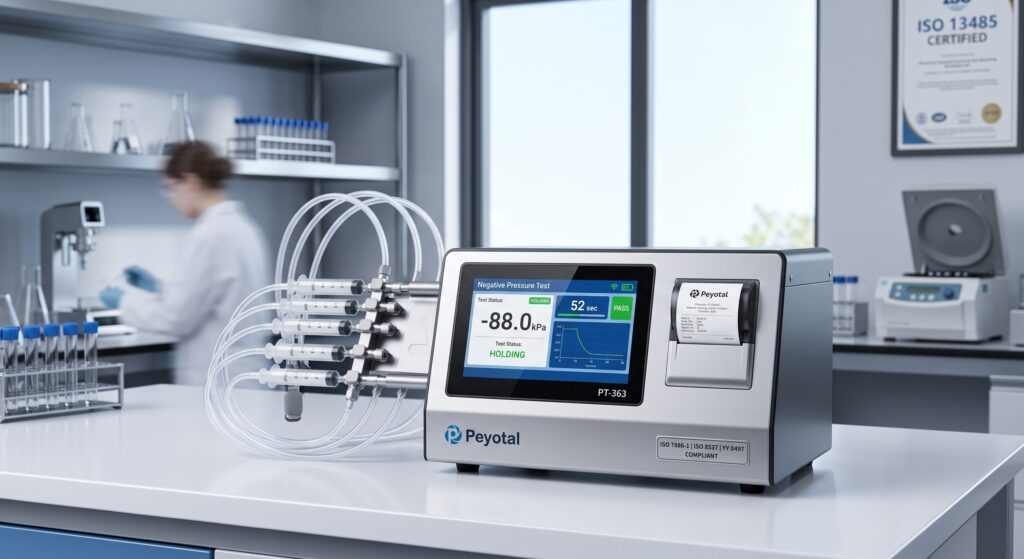
- Vacuum Application: The instrument applies a regulated negative pressure of -88 kPa (±0.3 kPa) to the syringe nozzle.
- Pressure Holding & Evaluation: The system maintains negative pressure for a designated holding period (typically 60 seconds). Sensors monitor for vacuum decay (drift must not exceed 0.5 kPa), while visual confirmation verifies no continuous bubble formation at the piston seal.
Overview: Peyotal PT-363 Syringe Air Leakage Tester
Designed specifically to meet the high-throughput demands of medical device factories and certified testing laboratories, the Peyotal PT-363 integrates intelligent control with robust mechanical stability.
| Feature / Parameter | Specification | Manufacturing & Lab Advantage |
| Negative Pressure Output | -88 kPa ± 0.3 kPa | Strict compliance with ISO 7886-1 & ISO 8537 |
| Adjustable Test Range | -5 kPa to -90 kPa | Versatility for non-standard R&D and custom testing |
| Control System | PLC Automation | High repeatability; eliminates operator-induced variance |
| Display Interface | 7-inch Color LCD | Real-time pressure curves and cycle timing visibility |
| Data Traceability | Built-in Thermal Micro-Printer | Immediate, unalterable physical records for audit trails |
| Applicable Standards | ISO 7886-1, ISO 8537, YY 0497 | Multi-market compliance certification |
Why Global Medical Manufacturers Partner with Peyotal
Medical manufacturing ecosystems in regions like Vietnam, Malaysia, Brazil, Mexico, Uzbekistan, and South Africa are rapidly upgrading production standards to expand export capabilities.
Peyotal (普优拓) delivers competitive advantages for manufacturing partners:
- Direct-from-Manufacturing Reliability: Engineered in-house with industrial-grade PLC controllers and high-precision pressure sensors.
- Audit-Ready Data Integrity: On-board printing and real-time parameter tracking simplify validation for ISO 13485 quality systems.
- Full-Spectrum Testing Solutions: Beyond air leakage, Peyotal provides integrated testing systems for positive pressure liquid leakage (PT-364), sliding force performance (PT-365), condom burst limits (PYT-140), and luer connector compliance (ISO 80369).
Optimize Your Quality Control Pipeline
Ensuring consistent compliance requires reliable, high-precision instrumentation. Whether setting up a new production cleanroom or upgrading an existing quality assurance laboratory, Peyotal provides standard and customized testing instrumentation tailored to international benchmarks.
- Explore Full Product Range: https://www.peyotal.com/
- Direct Technical Inquiries & Quotes: Vincent@peyotalinstrument.com