
One Number That Changes the Decision
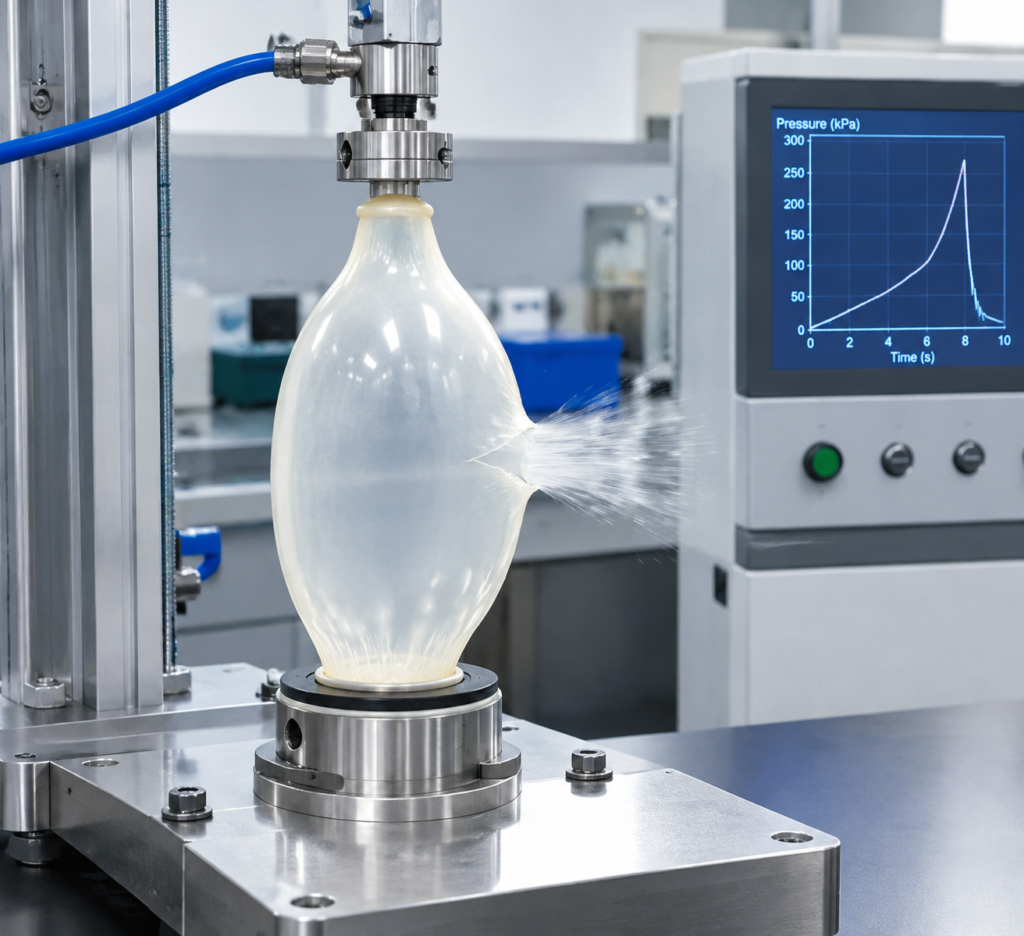
A single rejected lot of 50,000 condoms costs more than the testing instrument that could have caught the problem before packaging. That is the reframe. Condom testing is not a compliance checkbox you satisfy once and forget. It is production economics, repeated on every batch, and the instrument you choose determines how many defective units reach your packaging line.
The buyer who treats the tester as a lab accessory pays for that decision in rejected product, rework, and delayed shipments. The buyer who treats it as a process control tool selects differently. This article walks through what actually matters when you compare instruments: the standards behind the specs, the test methods that produce real data, and the questions that separate a useful quote from a generic one.
Why Condom Testing Fails on the Line
A recurring pattern shows up in our conversations with manufacturers. The buyer validates an instrument in a lab, runs a few samples, sees acceptable results, and places the order. Then the instrument arrives on the production floor, and the first full lot fails. The instrument itself is not broken. The problem is that lab validation and production testing are different jobs.
Lab validation uses a handful of samples, often handled carefully, tested under stable conditions. Production testing runs thousands of pieces, fed by operators, at line speed, in an environment with temperature swings and vibration. An instrument that produces repeatable results on 20 samples can drift badly on lot 47 of the day.
The root cause is almost always a mismatch between the instrument’s design and the production condition. Air pressure fluctuations, sample handling differences, or a test chamber that cannot hold temperature within the required range will each produce failures that have nothing to do with the condom itself. The fix is to specify the production condition when you request a quote, not after the instrument arrives.
What the Standards Actually Cover
Standards define the test methods, the sample sizes, and the acceptance criteria. Matching your instrument to the right standard is the first step, because each one governs different aspects of the product.
| Standard | Scope | What It Governs |
|---|---|---|
| ISO 4074 | Natural rubber latex condoms | Sampling plans, air burst, water leak, tensile properties, and dimensions |
| ASTM D3492 | Latex condoms (US market) | Similar coverage to ISO 4074, with US-specific sampling and reporting |
| GB 7544 | Condoms for the Chinese market | Test methods and acceptance criteria aligned with ISO 4074 |
| ISO 23409 | Synthetic condoms | Test methods adapted for polyurethane and other non-latex materials |
ISO 4074 is the baseline for most manufacturers. It specifies the air burst test for strength, the water leak test for pinholes, and tensile testing for material properties. ASTM D3492 covers the same ground for US-bound product. GB 7544 applies when your target market is China. ISO 23409 matters only if you produce synthetic condoms, where the test parameters differ from latex.
The practical point: your target market determines the standard, and the standard determines which test methods your instrument must support. An instrument built for ISO 4074 alone will not serve a buyer shipping to China under GB 7544 without verification of the differences.
The Test Methods Behind the Specs
Each test method measures a different failure mode. Air burst tests the overall strength of the condom under internal pressure. Water leak detects pinholes by filling the condom and checking for seepage. Tensile testing measures the material’s elongation and force at break. Pinhole testing, where separate from water leak, uses an electrical method to detect holes in the latex film.
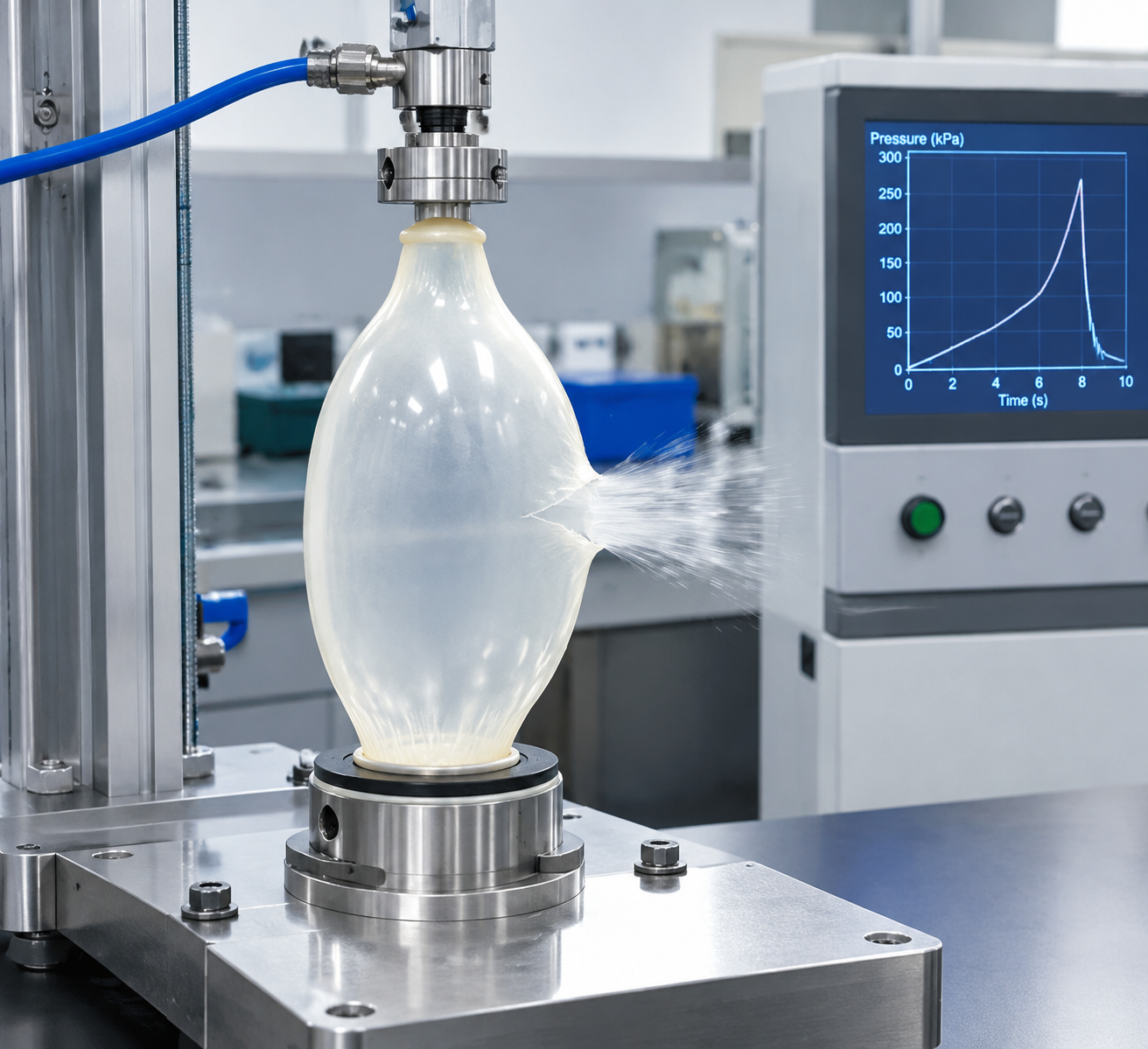
The table below links each method to the standards that require it and the typical acceptance criteria.
| Test Method | Measures | Governing Standard | Typical Pass Criterion |
|---|---|---|---|
| Air burst | Burst volume and pressure | ISO 4074, ASTM D3492 | Minimum burst volume per condom width, per standard table |
| Water leak | Pinholes and leaks | ISO 4074, GB 7544 | Zero leaks in the tested sample set |
| Tensile | Force and elongation at break | ISO 4074, ASTM D3492 | Minimum force and elongation per standard |
| Electrical pinhole | Hole detection in film | ASTM D3492 | No holes above the detection threshold |
The acceptance criteria are not universal. They vary by condom width, thickness, and the standard edition in force. A pass criterion for a 52 mm condom differs from one for a 60 mm condom. When you compare instruments, ask how the pass criteria are configured and whether the instrument can be updated when a standard revision changes the numbers.
What We Need From You to Quote
A meaningful quote starts with your test requirements. Send us the standard you are targeting — ISO 4074, ISO 23409, ASTM D3492, or GB 7544 — and the test method that standard requires. Air burst, water leak, tensile, and electrical pinhole each need different fixtures and transducers, and quoting the wrong one wastes everyone’s time.
We also need your sample size per lot, your daily production volume, and the environmental conditions where the instrument will run. Temperature and humidity affect both the condom material and the measurement itself. A unit specified for a 23 °C lab is not the same machine you need for a 35 °C production floor.
Missing any of these means we quote a generic instrument. That quote will be wrong in one direction or the other: overbuilt and overpriced, or underbuilt and failing your lot release. The more complete your spec, the closer the first quote is to the final order.
When a Condom Testing Instrument Is the Wrong Choice
A dedicated testing instrument is not always the right purchase. If your volume is under roughly one lot per week, the fixed cost of the instrument, calibration, and operator training rarely pays back. A third-party laboratory running the same tests on a per-lot basis is usually cheaper and gives you an independent result.
The same applies if you need only one test. A water leak tester alone may cost less than a full system, but if you only need tensile strength for a material qualification, a universal test machine you already own may cover it. Check whether your existing equipment can run the method with the right grips and load cell before buying a dedicated unit.
Buy the dedicated instrument when you have ongoing production, multiple tests per lot, or a regulatory requirement for in-house release testing. For occasional verification, outsource it.
How to Validate the Instrument Before You Commit
A verification protocol on the candidate unit takes a day and saves you from discovering problems after payment. Run it before any commitment.
Reference materials come first. Condoms from a lot that has already passed testing at a certified laboratory are the benchmark. Run them on the candidate instrument and compare the results to the lab’s reported values. The numbers should match within the instrument’s stated accuracy, with pass/fail as only the coarse check.

Repeatability follows. The same set of condoms runs through the instrument five times, in the same conditions, and the spread of results is recorded. A reliable instrument gives a coefficient of variation under 2% for air burst volume and under 1% for water leak detection. Wider spreads indicate sensor drift, inconsistent clamping, or temperature sensitivity.
Failure modes are tested deliberately. A known-good condom with a visible pinhole introduced by a fine needle must be rejected every time. A condom with a weak seam but no hole should pass the leak test but fail the burst test. This confirms the instrument distinguishes between failure types instead of flagging everything.
Environmental tolerance is the final check. The repeatability test runs at the temperature and humidity of your actual production floor, not in a controlled lab. Readings that shift with ambient conditions mean you need either a different unit or an environmental enclosure.
Lifecycle Cost: Maintenance and Replacement
The purchase price is a fraction of what the instrument costs over its working life. Plan for calibration, wear parts, and eventual replacement.
Calibration intervals depend on the sensor type and how hard the instrument runs. Pressure transducers for air burst testing typically need calibration every 12 months. Leak test systems with electronic flow sensors may need it every 6 months if they run continuously. Factor the calibration cost and downtime into your per-lot cost from the start.
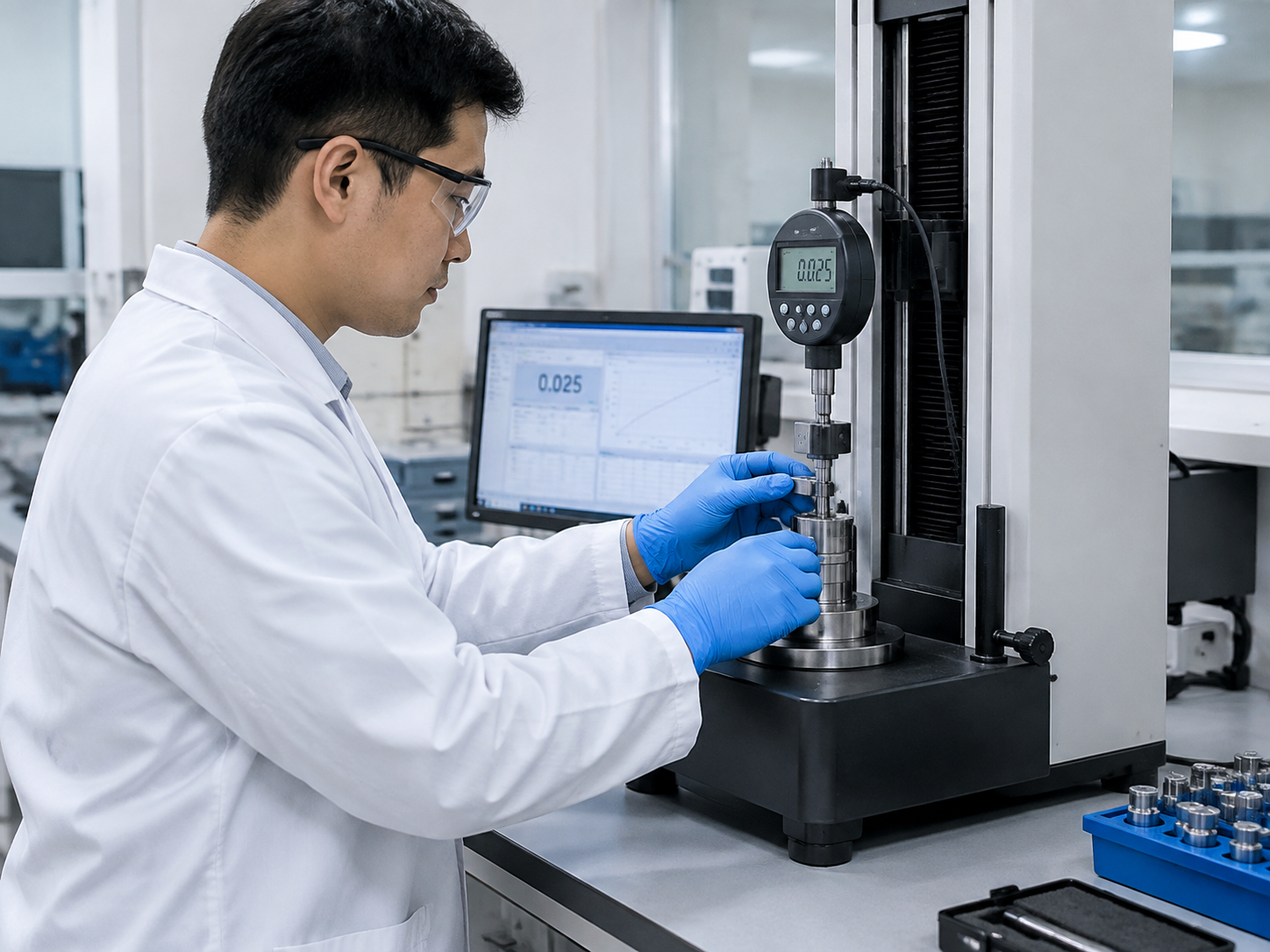
Wear parts are predictable. Seals and gaskets in the water leak test chamber degrade with exposure to water and cleaning agents, so budget for replacement every 12 to 18 months. Clamping jaws that grip the condom during burst testing wear with use; inspect them monthly and replace when the grip pattern becomes smooth.
The instrument’s electronic lifespan is typically 8 to 10 years. After that, sensors drift beyond calibration range and replacement parts become harder to source. The replacement cost belongs in your capital budget for year 8, before the unit fails and forces an unplanned purchase.
A simple rule applies: when the annual calibration and parts cost exceeds 15% of the original purchase price, the instrument is costing you more than a replacement would. That calculation should be run every year as part of your maintenance review, alongside the calibration schedule itself.
Common Specification Gaps That Delay Quotes
A quote request that says "condom testing per ISO 4074" sounds complete. It is not. The standard specifies multiple test methods, and each one changes the instrument’s configuration, fixtures, and software.
The gaps that stall a quote are the details the buyer already knows but forgets to write down. Sample size per lot, test speed, and the temperature condition all affect the build. Without them, we can only guess, and a guess is not a quote.
| Specification gap | What we need instead |
|---|---|
| "ISO 4074 compliance" | The specific clauses: air burst, water leak, tensile, or all |
| "Room temperature" | The exact condition: 23 °C or 35 °C, with tolerance |
| "Sample testing" | Lot size and samples per lot, e.g., 315 pieces per 100,000 lot |
| "Fast testing" | Cycle time target in seconds per test, plus batch size |
Specify the test method, the sample count, and the temperature. That is enough to quote.
Questions Buyers Ask Before Ordering
How often does the instrument need calibration?
Calibration intervals depend on usage and the reference standards you must meet. Most buyers schedule calibration annually, but high-volume lines typically verify monthly against a reference set. The instrument’s software should log each calibration event so you can trace results back to the last verified state.
What sample size do we actually need?
The standard dictates the minimum. ISO 4074 specifies sampling plans based on lot size, and the instrument must handle the full plan in one run. If you test 315 pieces per lot, the instrument needs the capacity and speed to finish that batch in a practical window. Confirm the lot size before ordering, because it determines the automation level you need.
Will the instrument handle future standard updates?
Standards evolve, but the physical test methods rarely change. Air burst and water leak testing have been stable for decades. What changes is the pass criteria and sampling statistics. Choose an instrument with software-based criteria that can be updated without hardware modification.
Can one instrument test different condom sizes?
Yes, but not without setup changes. A 52 mm and a 60 mm condom require different test fixtures or adjustable tooling. Specify the size range you produce, and the instrument can be configured to switch between them.
What happens when a test fails?
The instrument should flag the failure, record the value, and let you decide whether to retest or reject the lot. It should not auto-pass or auto-fail without your review.
What We Deliver and What We Don’t
We supply the instrument, the fixtures, and the software that runs the test methods you specify. We configure it to your standard, your sample size, and your condom dimensions. We provide documentation for calibration and validation.
We do not supply condoms, reference materials, or a calibration service. We do not certify your product or your lab. Those are separate contracts with accredited bodies.
What you get from us is a machine that performs the test you asked for, repeatably, and the support to keep it running. If you need certification, we will tell you who to call.
Next Step: Send Us Your Spec
Send us your test requirements: the standard, the clauses, the sample size, the condom dimensions, and the temperature condition. We will respond with a configuration and a quote. If your requirement is unusual, we will tell you that too.