

Understanding the technical disconnect between in-house factory testing and ISP border protocol is critical for manufacturers targeting public and commercial supply contracts in Chile.
The Port Audit Mechanism: NCh ISO 4074 Enforcement
Chilean regulatory oversight operates under the national adaptation of international standards, primarily NCh ISO 4074. Port audits conducted under ISP jurisdiction focus heavily on three physical integrity metrics:
- Air Burst Volume and Pressure (AQL 1.5): Random samples from imported lots undergo destruction testing to determine inflation resistance limits.
- Barrier Integrity via Pinhole Detection (AQL 0.25): Both water leakage and dry high-voltage testing confirm the total absence of micro-apertures.
- Packaging Seal and Dimensional Compliance: Verification of foil hermetic sealing, lubricant volume, and uniform width tolerances.
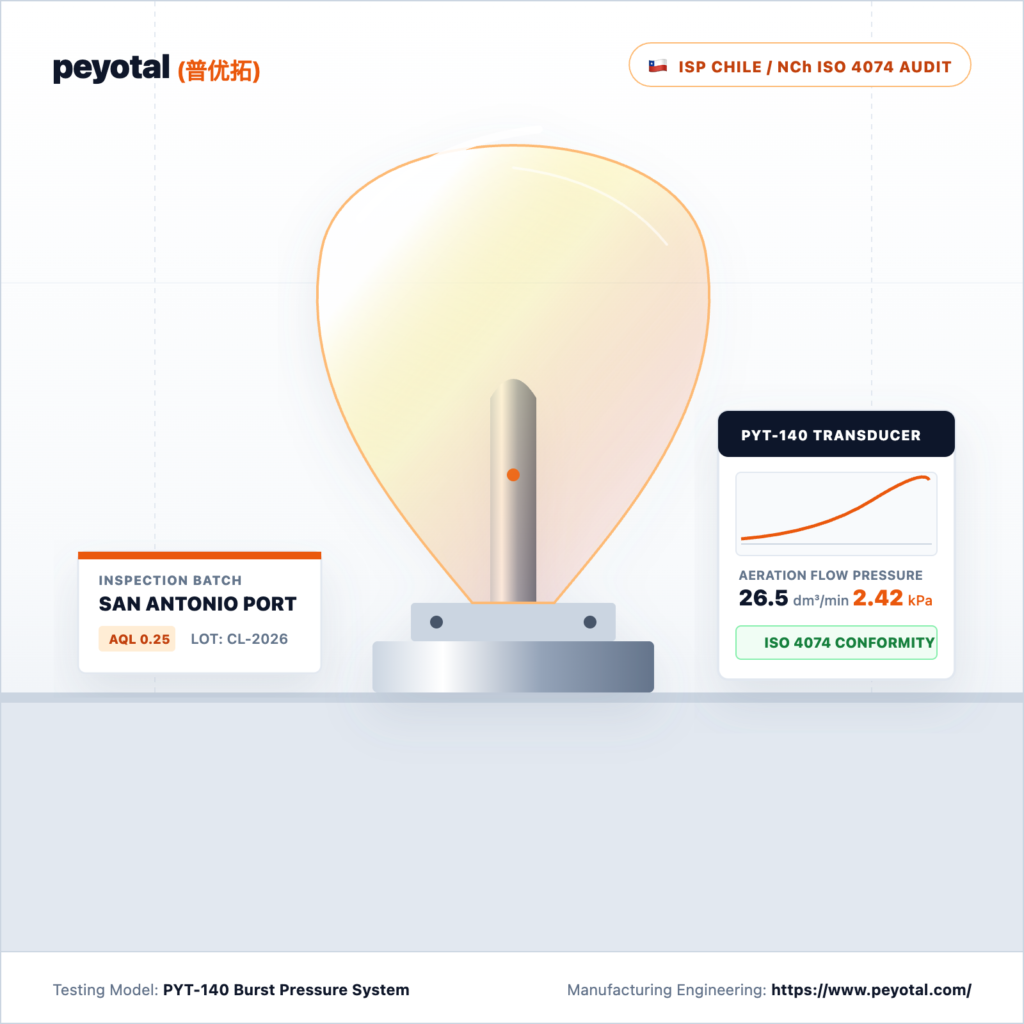
If an audited sample exceeds the allowable Acceptance Quality Limit (AQL), the entire shipment is blocked. Unlike domestic distribution channels where rework might be possible, a border rejection in San Antonio or Valparaíso incurs steep demurrage fees and immediate loss of commercial standing.
Why Factory In-House Tests Diverge from ISP Border Checks
The root cause of unexpected import failures rarely stems from deliberate corner-cutting; it typically originates from subtle measurement variances across distinct laboratory setups:
- Unregulated Inflation Delivery Rates: ISO 4074 strictly mandates an aeration delivery rate between 24 and 30 dm³/min. If a factory’s compressed air line experiences pressure drops during high-volume testing, the air delivery slows down. Slower inflation alters the strain crystallization dynamics of natural rubber latex, artificially inflating recorded volume values. When the Chilean verification lab applies a precisely calibrated flow rate, the recorded burst values drop below the legal compliance curve.
- Ambient Thermal and Humidity Shock During Transit: Maritime shipping across tropical equatorial lanes exposes container cargo to persistent heat and humidity fluctuations. If latex compounding lacks thermal stability, the rubber film undergoes accelerated physical aging. What passed as pliable latex in Asia or Central America arrives in South America with micro-embrittlement, failing elasticity thresholds upon arrival.
- Micro-Pinhole Detection Blind Spots: In-line electronic dry screening at the factory can fail to detect pinholes smaller than 20 microns if ambient electrostatic conditions or mold release powders temporarily bridge the gap. Once cleared through customs testing where liquid contact dissolves surface residues, continuous leakage is immediately caught.
Technical Protocol Comparison: In-House QC vs. ISP Regulatory Audit
| Audit Metric | Factory Release Environment | ISP Port Verification Protocol | Common Failure Root Cause |
| Burst Volume & Pressure | Continuous in-line / offline sampling | Regulated chamber inflation under ISO 4074 | Airflow delivery deviation outside 24–30 dm³/min |
| Pinhole Integrity | High-speed automated dry testing | Standard water fill / precision conductivity (AQL 0.25) | Powder masking micro-punctures during dry testing |
| Clamping Mechanics | Standard pneumatic clamps | Calibrated radius clamping ring (40 mm ID) | Edge pinch tears misidentified as mid-body bursts |
| Data Logging | Batch log sheets | Traceable electronic & printed audit reports | Uncalibrated sensor drift (>0.01 kPa variance) |
Standardizing Testing Instrumentation for Chilean Market Access
Passing ISP port audits requires factory laboratories to replicate the exact mechanical rigor utilized by national verification agencies.
At Peyotal, our testing systems are engineered directly to mitigate laboratory discrepancies:
- Peyotal PYT-140 Automated Condom Burst Tester: Delivers an automated, steady-rate aeration system maintained strictly at 24–30 dm³/min with high-accuracy pressure transducers (0.01 kPa resolution) to mirror international audit environments.
- Traceable Audit Documentation: Real-time data acquisition and built-in thermal reporting capture exact burst volume (0–60 dm³) and pressure (0–5.0 kPa) curves at the instant of explosion, providing tamper-proof QC archives for regulatory submission.
- Direct Manufacturing Support: Supplying global consumable plants with testing machinery built to eliminate export batch rejection risks.
Establishing reliable pre-shipment compliance testing ensures uninterrupted clearance through Chilean ports and protects your distribution contracts across South America.
- Explore Laboratory Equipment: https://www.peyotal.com/
- Direct Technical Inquiries: Vincent@peyotalinstrument.com