

Brazil’s National Health Surveillance Agency (ANVISA) has intensified its technical review and post-market surveillance of sterile, single-use hypodermic syringes. Coupled with INMETRO compulsory certification protocols, physical test data confirming barrel-and-piston leak-tightness has become a primary checkpoint during factory regulatory submissions, port-of-entry sampling, and unannounced facility audits.
For medical device manufacturers exporting to Brazil, factory release certificates alone often prove insufficient. Discrepancies between routine in-house quality checks and third-party laboratory verification frequently result in non-conformities (NC), customs delays, or commercial quarantine. Understanding the technical triggers behind these audit failures is essential for sustaining compliant distribution across Latin American healthcare systems.
The Audit Core: Understanding ANVISA Tightness Mandates
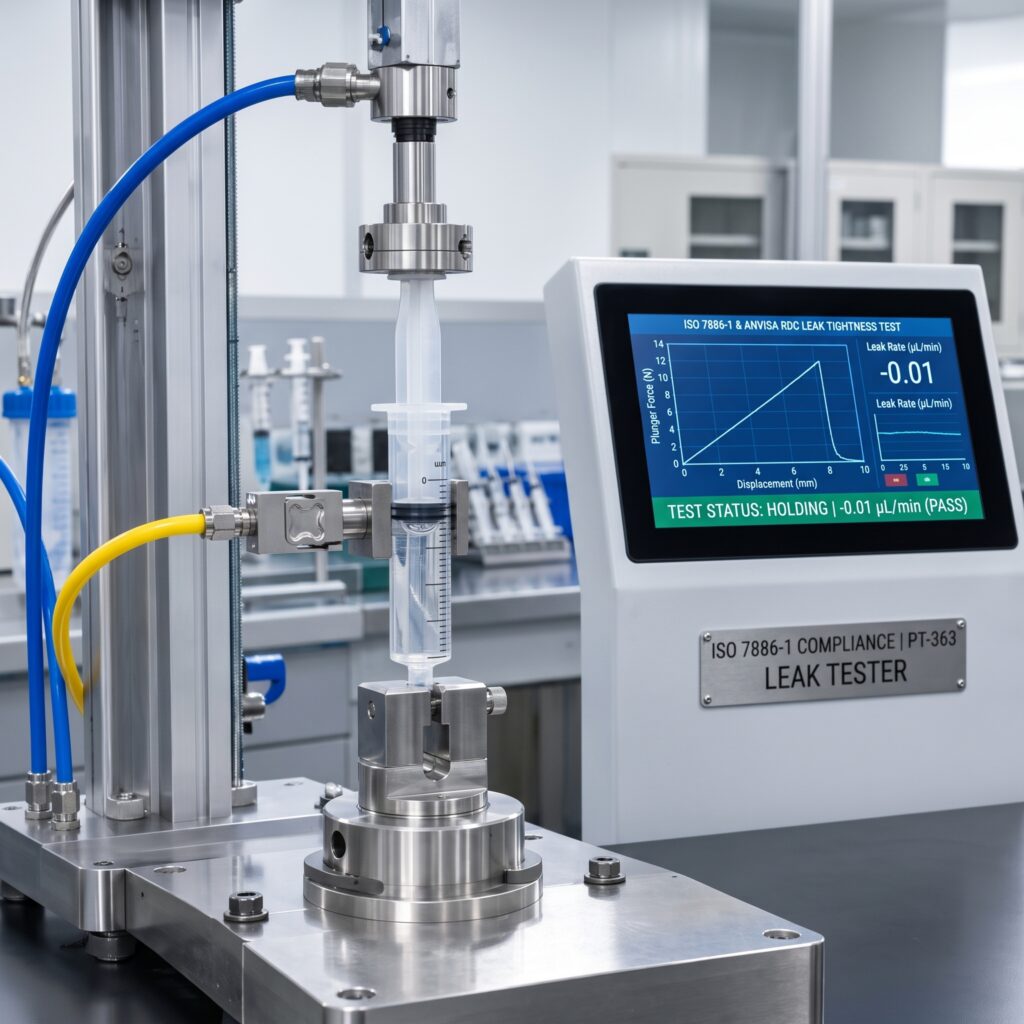
Under the normative framework aligned with ISO 7886-1 and Brazilian technical standards, regulatory inspectors evaluate syringe integrity across two distinct, non-interchangeable physical tests:
1. Air Leakage During Aspiration (Negative Pressure)
- Testing Protocol: The syringe is filled with water to a designated volume and coupled to an automated vacuum source, which draws and holds a sustained negative pressure of -88 kPa for a minimum of 60 seconds.
- Audit Failure Criteria: Continuous formation of air bubbles at the piston-barrel contact interface, measurable vacuum gauge drift exceeding 0.5 kPa, or separation of the piston stopper from the plunger rod.
- Common Factory Oversight: Utilizing manual vacuum pumps or unstable vacuum lines that suffer pressure fluctuation, or truncating the hold time to under 60 seconds, which allows micro-channels in the elastomer to escape detection.
2. Liquid Leakage Under Compression (Positive Pressure & Side Force)
- Testing Protocol: Under hydraulic fluid compression, the syringe is subjected to an axial pressure between 100 kPa and 400 kPa, applied simultaneously with a calibrated lateral deflection force on the plunger rod.
- Audit Failure Criteria: Fluid bypass across the elastomeric seal rings, mechanical detachment at the nozzle/luer interface, or visible liquid bead formation along the barrel wall.
- Common Factory Oversight: Testing purely under axial force while omitting the standardized side-load fixture, failing to reproduce the piston tilting that occurs during actual clinical injection.
Why Factory QC Data Diverges from Port Authority Audits
Even when production batches show clean initial records, three structural variables often lead to audit failures upon arrival in Brazil:
- Inadequate Holding Stability: ISO 7886-1 explicitly requires maintaining -88 kPa for 60 seconds. Basic analog vacuum gauges often mask slow pressure loss that precise digital sensors capture instantly.
- Viscoelastic Relaxation During Maritime Transit: Syringe barrels and elastomeric stoppers undergo thermal stress during multi-week ocean freight across equatorial routes. If pre-shipment tolerances are marginal, silicone distribution shifts and dimensional creep can reduce sealing pressure below compliance thresholds.
- Audit Trail & Data Traceability: ANVISA auditors require unalterable test logs. Manual logbooks without time-stamped pressure curves and automated printouts are routinely rejected as insufficient evidence of batch conformity.
Protocol Comparison: Routine Factory QC vs. Regulatory Inspection
| Inspection Parameter | Routine Production Line Sampling | ANVISA & INMETRO Audit Standard | Primary Risk of Non-Conformity |
| Negative Pressure Tightness | Rapid suction check (<20 s) | Continuous -88 kPa draw held for 60 s | Overlooked micro-bubbles; unmonitored vacuum drift |
| Liquid Seal Verification | Static axial push; no side force | 100–400 kPa axial pressure + lateral deflection load | Fluid bypass triggered by plunger tilting |
| Data Record | Hand-written batch log sheets | Automated PLC operation with printed parameters and timestamps | Rejected traceability documentation during audits |
Peyotal Testing Solutions for Latin American Compliance
To eliminate testing discrepancies before shipments depart for Brazil, Peyotal provides laboratory-grade verification instruments built strictly around ISO 7886-1 requirements:
- Peyotal PT-363 Syringe Air Leakage Tester: Driven by an industrial PLC and a 7-inch color LCD display, the system provides automated negative pressure output at -88 kPa ±0.3 kPa with zero drift over customizable durations (1–9999 s). The built-in printer outputs immediate, tamper-proof audit records for regulatory filing.
- Peyotal PT-364 Syringe Liquid Leakage Tester: Delivers precise 100 kPa to 400 kPa axial pressure control and integrates standardized lateral deflection fixtures for syringes ranging from 1 ml to 60 ml, identifying seal failure thresholds under simulated clinical side loads.
- Comprehensive Quality Assurance: Every machine includes calibration certification and technical documentation designed to substantiate tender submissions and factory audit trails worldwide.
Standardizing laboratory verification to international audit benchmarks protects your commercial contracts and ensures uninterrupted market entry into Brazil.
- Explore Syringe Testing Equipment: https://www.peyotal.com/
- Technical Consultation & Inquiries: Vincent@peyotalinstrument.com