

Public healthcare procurement administered through Vietnam’s Ministry of Health (MoH) and provincial Department of Health (DoH) hospital consortia has introduced more rigorous compliance screening for imported single-use sterile hypodermic syringes. Centralized bidding groups and provincial hospital panels across Hanoi and Ho Chi Minh City now routinely enforce strict pre-qualification audits, demanding verified batch-release laboratory data to combat fluid leakage, air aspiration risks, and inconsistent silicone distribution.
For medical device exporters and regional tender suppliers, securing a bid allocation is no longer solely about pricing competitiveness. Hospital evaluation councils frequently send tender sample lots to accredited third-party verification bodies (such as designated QUATEST testing institutes) to corroborate factory quality certificates against international benchmarks. Discrepancies between routine manufacturer in-house logs and regulatory lab audits increasingly result in bid disqualification, bond forfeiture, or multi-year blacklisting from national healthcare tenders.
The Regulatory Core: Why Negative-Pressure Leak Verification Dominates Tender Evaluations
Under national tender technical specifications governed by Vietnamese standards harmonized with ISO 7886-1, evaluating barrel-and-piston integrity centers on physical seal stability under mechanical stress:
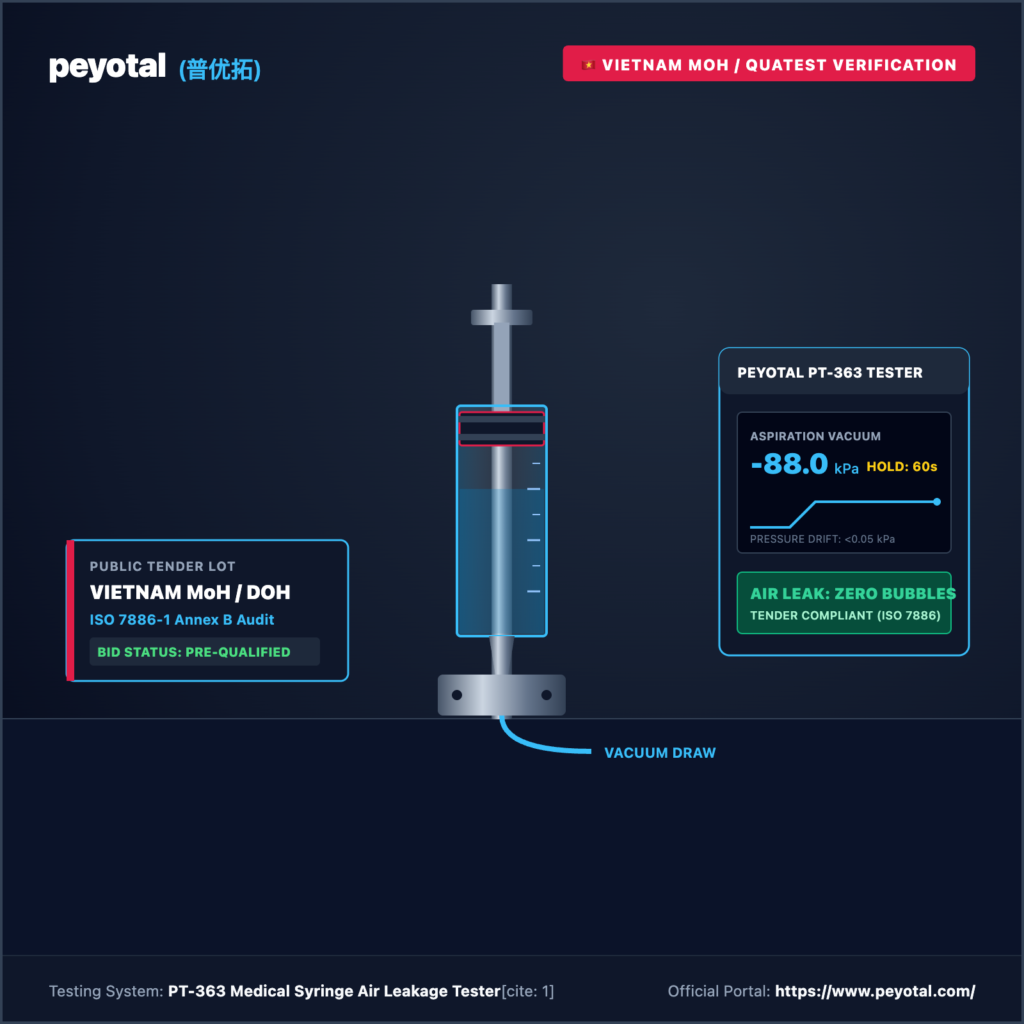
1. Air Leakage During Aspiration (-88 kPa Vacuum)
- Testing Protocol: Syringes are charged with degassed water to nominal capacity, connected to a regulated vacuum generation line, and subjected to a continuous negative gauge pressure of -88 kPa maintained for 60 seconds.
- Audit Failure Criteria: Continuous bubbling at the piston-to-barrel seal interface, measurable vacuum drift exceeding 0.5 kPa across the observation window, or catastrophic piston detachment from the push rod.
- Common Factory Oversight: Utilizing unregulated manual syringe aspirators or centralized plant vacuum feeds that suffer pressure fluctuations during high-volume testing. Implementing a closed-loop [Medical Syringe Air Leakage Tester] (Internal Link: PT-363 Product Page) provides digital stabilization that eliminates these false-pass deviations before dispatch.
2. Fluid Containment Under Axial and Deflection Forces
- Testing Protocol: While syringe aspiration tests verify air exclusion, tenders equally audit positive fluid containment under compression (100 kPa to 400 kPa) combined with side loads between 0.25 N and 3.0 N.
- Audit Failure Criteria: Fluid bypassing the elastomeric sealing ribs or nozzle seam failure under lateral deflection during clinical push-down.
- Common Factory Oversight: Testing purely under straight axial compression while omitting lateral load fixturing. Routine batch verification using an automated [Medical Syringe Liquid Leakage Tester] (Internal Link: PT-364 Product Page) ensures mechanical compliance under full clinical tilt simulation.
Root Causes of Batch Discrepancies in Southeast Asian Shipments
Even when lots clear manufacturing plants with factory release sheets, sample verification within Vietnam frequently flags non-conformities due to three operational factors:
- Inadequate Vacuum Dwell Cycles: Production floor QC operators often truncate inspection holding intervals to under 20 seconds during rush runs. Standard ISO 7886-1 procedures mandate an uninterrupted 60-second draw; elastomeric micro-grooves frequently fail to show air ingress until 35 to 45 seconds of sustained negative stress.
- Equatorial Transit and Silicone Migration: Sea freight containers transiting tropical shipping lanes experience high ambient heat and humidity. Excessive thermal cycling can cause medical-grade silicone oil to migrate unevenly along the barrel wall, resulting in localized dry zones where air channels develop under vacuum.
- Missing Audit Trails and Calibration Data: Public tender verification panels require unalterable, time-stamped parameter logs. Hand-written checklists lacking real-time pressure curves and physical test receipts are routinely rejected as non-verifiable documentation by MoH bidding committees. Deploying an automated [Syringe Tightness Tester] (Internal Link: Syringe Testing Category Page) with direct thermal printing bridges this documentation gap.
Protocol Comparison: Routine Factory QC vs. Vietnam Tender Audit
| Verification Metric | Factory Production-Line Practice | Vietnam MoH Tender & QUATEST Verification | Primary Risk of Bid Disqualification |
| Negative Pressure Aspiration | Rapid vacuum pull (<20 s hold) | Regulated -88 kPa continuous draw held for 60 s | Delayed bubble emergence past piston ribs |
| Piston Side Load Resistance | Static axial push only | Simultaneous 100–400 kPa axial pressure + lateral force | Seal bypass caused by clinical plunger tilting |
| Data Integrity & Reporting | Internal shift paperwork | Machine-generated digital records with printed test logs | Rejection of submission due to unverified QC claims |
Peyotal Testing Instrumentation for Public Healthcare Tenders
To ensure batch integrity before containers arrive at Vietnamese ports or tender evaluation centers, [Peyotal Instrument] (Internal Link: Homepage – www.peyotal.com) provides laboratory test benches engineered to meet ISO 7886-1 requirements:
- [Peyotal PT-363 Syringe Air Leakage Tester] (Internal Link: PT-363 Product Page): Powered by an industrial PLC with a 7-inch color touch interface, providing regulated negative pressure down to -88 kPa ±0.3 kPa with zero pressure drift over configurable testing durations (1–9999 s). Includes an integrated micro-printer for tamper-proof compliance receipts required during tender dossier submission.
- [Peyotal PT-364 Syringe Liquid Leakage Tester] (Internal Link: PT-364 Product Page): Features controlled 100 kPa to 400 kPa axial loading mechanics paired with standardized lateral deflection clamps for syringes from 1 ml to 60 ml, pinpointing seal failure thresholds under simulated clinical use.
- Complete Quality Assurance: Calibrated to international metrology standards, supporting consumable production plants across Southeast Asia, Central Asia, Africa, and Latin America. In addition, when tender specifications require verifying plunger glide resistance, the [Medical Syringe Sliding Performance Tester] (Internal Link: PT-365 Product Page) evaluates break-loose and sustained extrusion forces to prevent piston binding during administration.
Standardizing testing instrumentation to regulatory tender benchmarks protects commercial bidding status and secures long-term public hospital contracts across Vietnam.
- Explore Syringe Testing Equipment: [Peyotal Medical Testing Solutions] (Internal Link: https://www.peyotal.com/)
- Tender Compliance & Quotation Inquiries: Vincent@peyotalinstrument.com